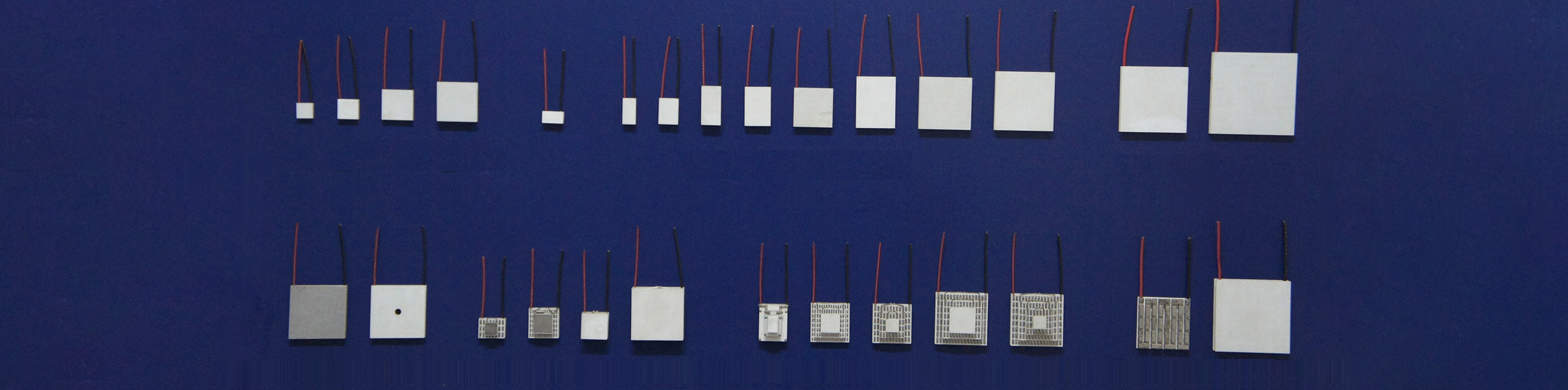
The application of peltier modules ,thermoelectric modules in temperature controllers
Thermoelectric cooling module(peltier element)—commonly referred to as thermoelectric coolers (TECs)—are integral components in high-precision temperature control systems. Their operation is grounded in the Peltier effect: when a direct current traverses a thermocouple formed by two dissimilar semiconductor materials, heat is absorbed at one junction (the cold side) and simultaneously rejected at the opposite junction (the hot side).
In integrated temperature control systems, thermoelectric modules ,peltier modules, TECs are paired with intelligent temperature controllers (i.e., thermostats) to enable bidirectional, active, and closed-loop thermal regulation with exceptional accuracy. Below is a structured analysis of their functional principles and practical implementation:
1. Core operational principle: Closed-loop bidirectional thermal regulation
A Thermoelectric cooling module,TEC functions solely as a heat transfer device and cannot autonomously determine whether to cool or heat; this decision-making capability resides entirely within the temperature controller—the system’s “central processing unit.” Equipped with a high-fidelity temperature sensor, the controller continuously monitors the actual temperature and compares it against user-defined setpoints:
• Cooling mode: When the measured temperature exceeds the upper setpoint, the controller applies a forward-biased current, maximizing heat extraction at the cold side.
• Heating mode: When the temperature falls below the lower setpoint, the controller reverses the current polarity, thereby interchanging the thermal roles of the two junctions and initiating active heating.
This current-reversal mechanism enables near-instantaneous thermal mode switching—without mechanical latency or thermal inertia—thereby offering superior dynamic response compared to conventional refrigeration systems that rely on separate heating elements and exhibit inherent mechanical delays.
2. Representative application domains
Owing to their compact footprint, silent operation, vibration-free performance, and temperature stability (achieving control precision of ±0.1 °C, and down to ±0.01 °C in optimized configurations), Thermoelectric module (peltier cooler) TEC-based thermal management systems are widely deployed across mission-critical sectors:
• Medical and life sciences: Polymerase chain reaction (PCR) thermal cyclers, next-generation gene sequencers, clinical biochemical analyzers, and temperature-sensitive vaccine transport containers—all requiring stringent thermal uniformity to ensure assay integrity and patient safety.
• Optical and photonic systems: Laser diodes, optical sensors, and infrared detectors, where minute temperature fluctuations induce wavelength drift or optical path distortion; precise TEC stabilization is therefore essential for maintaining signal fidelity in optical communications and surface metrology of high-precision optics.
• Industrial and semiconductor manufacturing: Photolithography steppers, plasma etching tools, ADAS imaging modules, and LiDAR transceivers—where thermal stability directly governs process repeatability, yield, and long-term equipment reliability under variable ambient conditions.
• Consumer electronics and portable devices: Smartphone thermal management modules, compact condensation-based dehumidifiers, miniaturized refrigeration units, and dermatological cold-compression devices—delivering quiet, refrigerant-free, and environmentally sustainable thermal solutions.
3. Critical subsystems enabling optimal thermoelectric TEC performance
To fully exploit the capabilities of peltier modules, peltier devices, TECs within a temperature control architecture, several interdependent subsystems must be rigorously engineered and co-optimized:
• PID-based feedback control: Given the inherent thermal inertia and nonlinear voltage–current–heat-transfer characteristics of TECs,peltier coolers, peltier modules advanced proportional-integral-derivative (PID) algorithms are employed to dynamically adjust drive current, eliminate steady-state error, suppress thermal oscillations, and sustain true isothermal operation.
• High-efficiency hot-side thermal management: As TECs function as heat pumps—not heat sinks—effective dissipation of waste heat from the hot side is paramount. System failure most frequently originates from inadequate hot-side cooling; therefore, high-conductivity aluminum or copper heat sinks, augmented by forced-air convection or liquid cooling loops, are standard practice.
• High-accuracy temperature sensing: Precision measurement relies on calibrated sensors such as NTC thermistors or PT100 platinum resistance thermometers. To minimize thermal interface resistance and ensure representative feedback, sensors must be physically mounted in intimate thermal contact with the controlled surface—typically secured using thermally conductive silicone grease and mechanically stabilized.
• Comprehensive protection circuitry: Robust temperature controllers incorporate multi-layer safeguards—including over current, overvoltage, over temperature, and short-circuit protection—to mitigate risks associated with transient reverse voltage events, thermal runaway, or abnormal operating conditions that could otherwise compromise Thermoelectric module,TEC module, TEC longevity or system safety.
4. Comparative assessment: Advantages and constraints
Advantages:
• Solid-state construction eliminates moving parts, ensuring silent operation, zero maintenance, and extended service life;
• Highly scalable form factor supports integration into space-constrained platforms;
• Rapid thermal polarity reversal enables agile operation across broad temperature spans (e.g., −50 °C to +80 °C);
• Refrigerant-free design aligns with global environmental regulations and sustainability objectives.
Limitations:
• Relatively low coefficient of performance (COP), particularly under large temperature differentials;
• Maximum cooling capacity is fundamentally constrained by hot-side heat rejection efficiency;
• Power consumption escalates significantly at extreme ΔT conditions;
• High-power TEC modules (thermoelectric modules) entail elevated material and fabrication costs, impacting overall system economics.
TES1-12106T125 Specification
Hot side temperature is 30 C,
Imax:6A,
Umax: 14.2V
Qmax:50.8 W
Delta T max: 67 C
Size :15X60X3.4mm ,hole diameter: 6.2
Ceramic plate: 96%Al2O3
Sealed: Sealed by 704 RTV (white color)
Wire: 22AWG PVC ,temperature resistance 80℃.
Wire length: 150mm
Thermoelectric material: Bismuth Telluride
Post time: Jun-25-2026


